Acids and Bases
|
|
HAVE YOU SEEN THIS MAN? Johannes Brönsted part
time chemist, part time serial killer Last known activity Basically accepting protons |

Three Theories:
I. Arrhenius Model
§
Acids produce H+ ions
§
Bases produce
II. Bronsted-Lowry Model
§
Acids = Proton
donors (form H3O+ Hydronium
ion)
§
Bases = Proton
acceptors
III.
Lewis Acid-Base Model
§
Acids = e-
pair acceptors
§
Bases = e-
pair donors
IV. Conjugate Acid-Base Pairs
§
Conjugate base is
what’s left after proton is donated from acid
§
Example: H2SO4
(Acid) + H2O (Base) → H3O+ (
pH & pOH:
- pH = -log ([H+]), pOH
= -log ([
- pH + pOH = 14
- Kw = [H+][
Dissociation:
- % dissociation = (amount dissociated (M)) / (initial
concentration (M)) * 100%
- K = [Products] / [Reactants]
- Example of dissociation of HA: Ka =
([H+][A-]) / [HA]
Acids:
- Common strong acids: HCl,
- Nonmetal oxides form acids when they react with
water
- Strong acids are associated with weak conjugate
bases
Bases:
- All Group 1A & Group 2A are strong except
Mg(OH)2 and Be(OH)2
- Metallic oxides of Group 1A and 2A form bases
when they react with water
- Strong bases are associated with weak conjugate
acids
Terms:
- Monoprotic – one acidic proton (HCl)
- Diprotic – two acidic protons (H2SO4)
- Triprotic – three acidic protons (H3PO4)
 Oxyacids – acids in which the acidic proton is attached
to an oxygen
Oxyacids – acids in which the acidic proton is attached
to an oxygen- Organic acids – contain carboxyl group (usually weak)
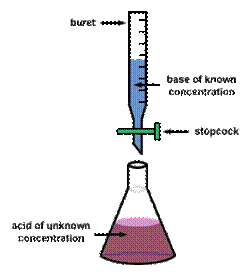
Titrations:
- Often used to determine the pH of a solution
- If titrating base with acid: indicator with color
change pH of +1 of pKa
- If titrating acid with base: indicator with color
change pH of -1 of pKa
